Polyphenols in Food: Why We Test Honey for Purity & Antioxidant Integrity
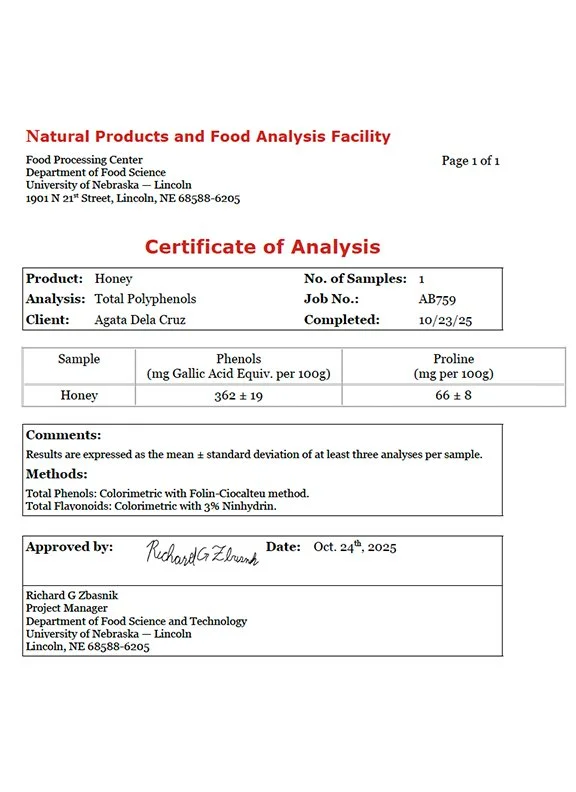
We rely on two essential measures to ensure that every harvest remains true to nature: comprehensive chemical-residue screening to rule out contaminants, and polyphenol analysis to confirm the integrity of antioxidants. Polyphenols in food are plant-derived compounds known for their antioxidant, anti-inflammatory, and longevity-supporting effects. While many foods with polyphenols contribute to cellular health, honey’s polyphenol content depends entirely on purity, forage diversity, and careful handling. That’s why we test every harvest — to protect the integrity of the hive, the vitality of the honey, and the well-being of the people who enjoy it. Below, you’ll find answers to our most frequently asked questions. If you’re curious about anything else, email us at hello@puristhoney.com
-
Polyphenols are naturally occurring plant compounds shown to help protect cells from oxidative stress, chronic inflammation, and cumulative cellular damage — key biological processes associated with aging over time. In modern life, these protective compounds have become increasingly important. Environmental chemical exposure, ultra-processed diets, psychological stress, and metabolic strain all contribute to a higher oxidative burden on the body than previous generations faced, increasing demand for nutrient-dense foods that support cellular resilience.
While there is no established daily requirement for polyphenols, peer-reviewed research consistently associates higher intake from whole foods with improved metabolic health, reduced inflammatory markers, and biological patterns linked to healthy aging. Observational studies suggest that diets providing approximately 650 milligrams of polyphenols per day — with some evidence supporting intakes closer to or exceeding 1,000 milligrams — are associated with lower disease risk and greater longevity. Polyphenols are naturally present in minimally processed foods such as fruits, vegetables, tea, olive oil, and raw honey. In honey, these compounds originate from the nectar and pollen of flowering plants, making it a genuine polyphenol-containing food whose nutritional value reflects the diversity, purity, and ecological integrity of its environment.
-
Polyphenols are transferred into honey from the nectar and pollen of the plants that bees forage. Each harvest reflects its unique botanical landscape — which is why plant diversity, environment, and handling matter.
Honey must remain raw and room-temperature processed, as heating destroys these delicate compounds.
Our honey is never heated — preserving its full nutritional expression.
-
1. Feed & Balance the Gut Microbiome
Honey acts as a natural prebiotic, nourishing beneficial gut bacteria.
Helps rebalance the microbiome by supporting the good and suppressing harmful microbes.
Influences serotonin production, supports estrogen metabolism, and strengthens immune function.
2. Fight Candida & Harmful Microbes
A 2021 study found honey can kill Candida, a fungus linked to bloating, sugar cravings, and skin issues.
Honey naturally contains propolis — antimicrobial, antibacterial, and prebiotic — which helps protect the gut ecosystem.
3. Repair the Gut Lining & Reduce Inflammation
Honey’s polyphenols and flavonoids help repair the gut lining and reduce oxidative stress within intestinal cells.
These compounds also protect mitochondrial health, essential for cellular repair, detoxification, and energy.
4. Support Healthy Aging
Polyphenols help counter the drivers of aging — oxidative stress, inflammation, and mitochondrial decline — through:
Antioxidant action: neutralizing free radicals.
Cellular renewal: promoting autophagy (the body’s natural clean-up process).
Mitochondrial support: protecting the energy centers of cells.
DNA & gene expression: supporting DNA repair and influencing longevity pathways.
Brain health: offering neuroprotective effects against age-related decline.
-
Not all honey contains meaningful levels of polyphenols. Honey’s polyphenol content is determined long before it reaches the jar — shaped by the diversity of flowering plants bees forage, the health of the surrounding ecosystem, and the way the honey is handled after harvest. When bees have access to a biodiverse landscape rich in native flora, polyphenols from nectar and pollen are naturally transferred into the honey, giving it antioxidant depth and biological complexity.
Equally important is what doesn’t happen in the hive. Practices such as synthetic feeding, monoculture foraging, or excessive harvesting interrupt the maturation process and dilute polyphenol expression. Heating during processing can further degrade these fragile compounds. Honey becomes a high-polyphenol food only when it is allowed to mature naturally, remain raw, and reflect the integrity of its environment — a process that cannot be rushed or engineered.
-
Polyphenols are delicate, plant-derived compounds that give honey its antioxidant, anti-inflammatory, and longevity-supporting properties. Their presence — and their effectiveness — depends entirely on the health of the ecosystem bees forage from and the conditions inside the hive. When bees are exposed to agricultural chemicals or synthetic treatments, those compounds don’t simply disappear; they disrupt the biological processes that allow polyphenols to be transferred from nectar and pollen into honey.
Many people assume a label reading “Raw & Pure” guarantees a clean, unadulterated product. Historically, honey was used as medicine for millennia — but today, with an estimated 76% of global honey showing contamination, that assumption no longer holds. A honey can be minimally processed and still carry residues from environmental spraying or conventional beekeeping practices, compromising both its safety and its antioxidant integrity.
Chemical residues in the hive can diminish honey’s medicinal value by interfering with polyphenol expression, degrading sensitive compounds, or introducing oxidative stress that counteracts their benefits. That’s why we test every harvest — not only to rule out what shouldn’t be there, but to protect what should. Chemical-residue testing is a foundational step in preserving the full nutritional and polyphenol profile of the honey we share.
-
Chemicals show up in hives in two primary ways:
1. Environmental Exposure
Forager bees bring back residues from landscapes treated with herbicides, fungicides, or pesticides — including conventional farms, roadside spraying, and common residential weed killers like RoundUp (glyphosate). Since bees can travel miles to forage, this is the hardest variable for beekeepers to control.
2. Beekeeping Practices
Many standard operations use synthetic chemical treatments inside the hive to manage disease — including substances like amitraz, which the State of California lists as causing reproductive harm in humans.
Both pathways contaminate honey, wax, pollen, and propolis, and can greatly reduce the purity and potency of hive products.
As a natural beekeeping operation, we avoid all chemical treatments and rely on ecological, season-aligned methods for colony health. Our hives are also placed within a carefully maintained no-spray protected radius — something we worked hard to secure.
-
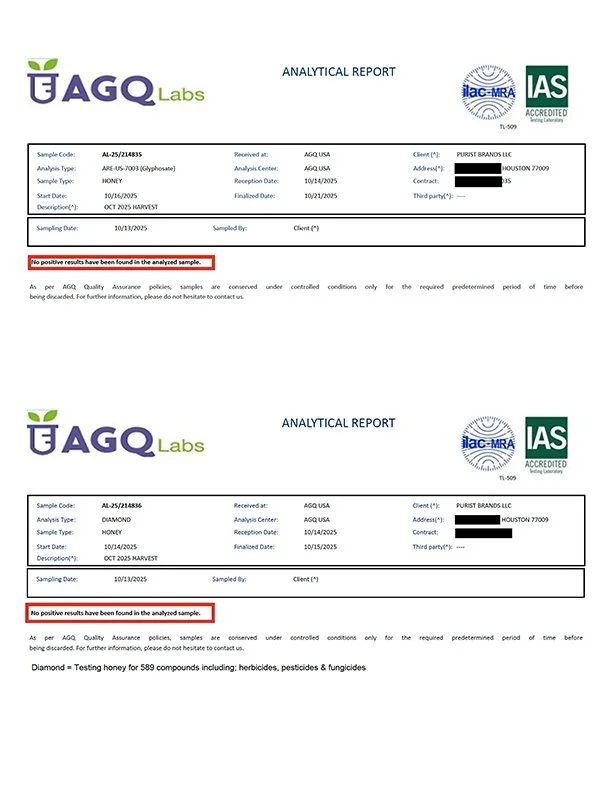
We test for 590+ contaminants, including herbicides, fungicides, pesticides, and glyphosate.
Comprehensive testing at this level is expensive — even for us — but it’s essential to uphold the standard we believe honey deserves. And it’s personal: our family consumes this honey daily. We want the same peace of mind for your home that we insist on for our own.
*All information is provided for educational purposes and reflects current research on polyphenols and food integrity. Our testing is conducted through independent, accredited laboratories using standardized polyphenol and chemical residue analysis methods. This is not medical advice.
Chemical Residue Lab Results
Antioxidant Lab Results